
- Home
- »
- Homecare & Decor
- »
-
Luxury Hotel Market Size & Share, Industry Report, 2033GVR Report cover

Luxury Hotel Market (2026 - 2033) Size, Share & Trends Analysis Report By Category (Chain, Independent), By Type (Business Hotels, Airport Hotels, Holiday Hotels), By Booking Mode (Direct Booking, Travel Agents, Online Travel Agencies), By Region, And Segment Forecasts
Market Size, 2025
$110.9BMarket Estimate, 2026
$118.4BMarket Forecast, 2033
$199.7BCAGR, 2026–2033
7.5%Luxury Hotel Market Summary
The global luxury hotel market size was valued at USD 110.9 billion in 2025 and is projected to grow from USD 118.4 billion in 2026 to USD 196.7 billion by 2033, at a CAGR of 7.5% from 2026 to 2033. The market in North America dominated with a revenue share of 36.1% in 2025. Growth in high-net-worth individuals (HNWIs) and affluent middle-class travelers has been a structural tailwind for the luxury hotel sector and the broader luxury hotel industry.
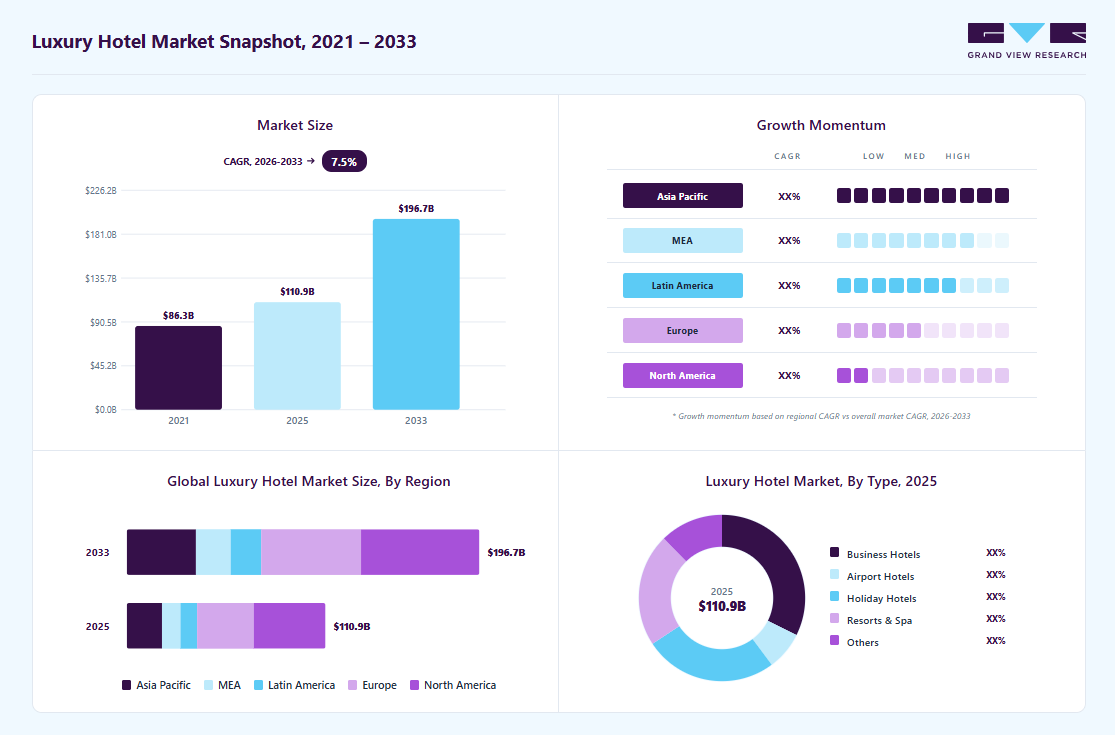 Source: Grand View Research, IR Documents, Primary Interviews, Paid DatabasesTo learn more about this report,
 Download Free Sample Report
 Key Market Trends & Insights
- By category: The luxury hotel chains segment held the largest revenue share of 65.2% in 2025.
- By type: The business hotels segment accounted for the largest share of 32.3% in 2025.
- By booking channel: The direct bookings segment held the largest revenue share of 42.7% in 2025.
Regional Highlights
- Largest regional market: North America (36.1% revenue share, 2025)
- Fastest-growing regional market: Asia Pacific (highest CAGR, 2026-2033)
- The luxury hotel industry in the U.S. held the largest revenue share in 2025.
Market Size & Forecast
- Market size in 2025: USD 110.9 Billion
- Estimated market size in 2026: USD 118.4 Billion
- Projected market size by 2033: USD 196.7 Billion
- CAGR (2026-2033): 7.5%
Three ways to get this report
Buy it, customize it, or ask a question.Ask an Analyst
Analyst response in 1 business day
- AccessReport author, directly
- Reply timeWithin 1 working day
- No sales callDirect answer only
- FormatEmail reply
- CostFree, no cost
Get the Full Report
What the study covers
- FormatsPDF · Excel · Dashboard
- Timeline2026–2033 annual, 2025 base
- Coverage20+ countries, 5 regions
- Companies10+ key players profiled
Customize the Report
20% free customization
- IncludeCountries, segments, points
- TailorTo your product definition
- ExtendDeeper competitor detail
- OrA fully bespoke study
- Turnaround5–10 working days
Rising wealth creation in technology, finance, entrepreneurship, and professional services has expanded the global base of consumers with discretionary income for premium travel. At the same time, a fast-growing affluent middle class, especially in emerging economies, has become more comfortable trading up from upper-midscale hotels to luxury stays for milestone trips, family vacations, and international travel. These travelers are less price-sensitive, travel more frequently, and tend to extend the length of stay, directly lifting average daily rates (ADR) and revenue per available room (RevPAR) for luxury properties. Importantly, this cohort also values brand reputation, service consistency, and exclusivity, encouraging luxury hotel groups to expand portfolios across resort, urban, and mixed-use formats to capture repeat demand across the luxury hotel industry.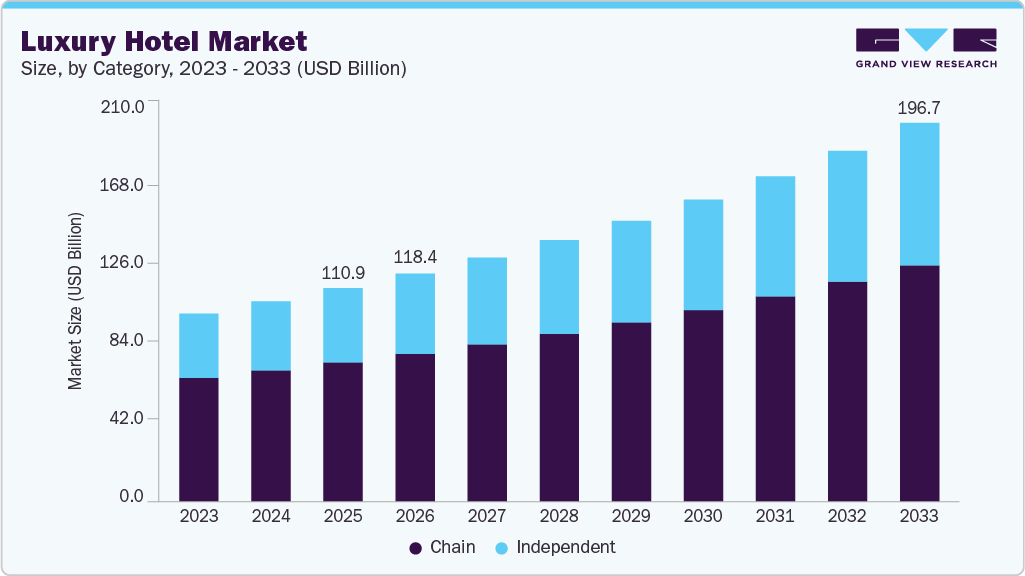 To learn more about this report, Download Free Sample Report
 Rising demand for experiential and personalized travel is reshaping how luxury hotels compete and differentiate within the luxury hotel industry. Today’s luxury traveler prioritizes unique, memory-driven experiences, such as private cultural immersions, curated wellness programs, destination dining, and bespoke itineraries, over standardized five-star offerings. Hotels are responding by investing in personalization through guest data, dedicated concierges, and flexible service models that adapt to individual preferences before, during, and after the stay. Custom room experiences, tailored wellness treatments, and hyper-local excursions have become core value drivers rather than add-ons. This shift allows luxury hotels to command premium pricing while strengthening guest loyalty, as travelers increasingly choose properties that deliver emotional value, authenticity, and a sense of exclusivity rather than just physical opulence.
Specialized operators and luxury hotel brands are propelling the luxury hotel industry forward. For instance, in February 2025, Brigade Hotel Ventures outlined plans to expand its hotel portfolio by adding five new properties across South India over the next few years. The proposed developments span luxury, upper-midscale, and wellness-led formats, aimed at strengthening the company’s presence in key urban and leisure destinations. This expansion is expected to significantly increase room inventory and reflects Brigade’s strategy to capitalize on sustained demand growth in India’s premium and resort hospitality segments.
Shifts in consumer preferences are reshaping the luxury hotel industry. Guests increasingly prioritize unique experiences over opulent formality, driving luxury hotels to offer cultural immersion, personalized services, and exclusivity. For instance, Soneva Secret in the Maldives features private villas, stargazing roofs, and dedicated staff for each guest. This aligns with a broader trend of integrating local traditions and curating unforgettable experiences for the modern luxury hotel target market. Partnerships with luxury brands, such as Four Seasons’ collaboration for lending high-end accessories, further highlight innovative efforts in the luxury hospitality space.
Sustainability is becoming a hallmark of the luxury hotel industry. Many properties focus on eco-friendly practices, such as using renewable energy, recycling materials, and supporting local communities. Soneva Fushi in the Maldives leverages solar power and waste recycling, while 1 Hotel Central Park integrates reclaimed wood and eco-conscious designs. Sustainable tourism offerings at hotels like Six Senses Southern Dunes and Lefay Resort underscore the growing demand for eco-luxury experiences. This balance between elegance and responsibility positions the luxury hotel industry for continued growth while aligning closely with the expectations of the evolving luxury hotel target market.
Brand Market Share Insights
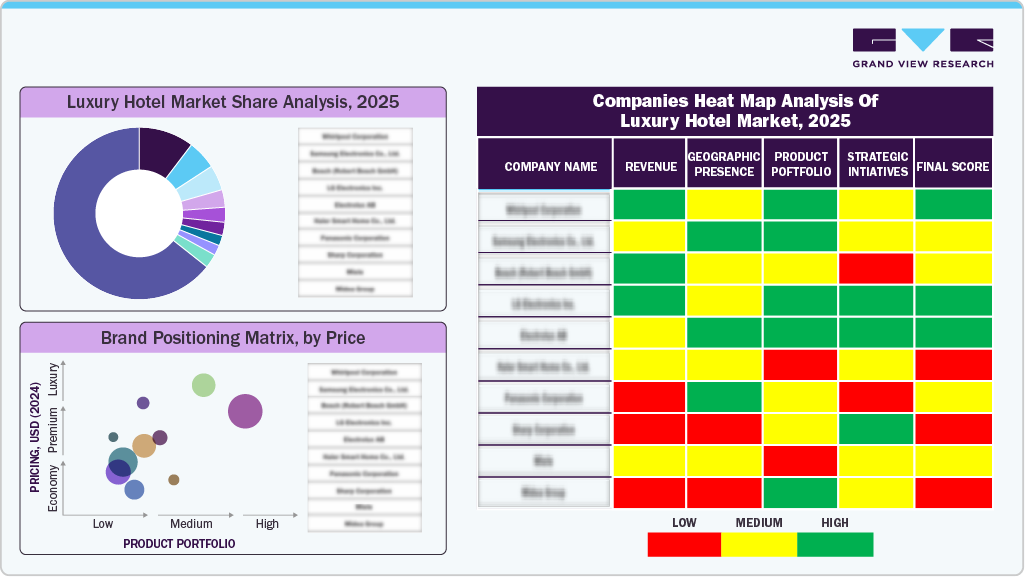
The luxury hotel industry is fragmented primarily due to the presence of several globally recognized players as well as regional players. Some prominent companies in this market are Accor, Belmond Management Limited, Four Seasons Hotel Limited, Mandarin Oriental Hotel Group Limited, and Aman Resorts, among others. Market players are differentiating through expansions, investments, and expanding their service offerings to cater to evolving consumer preferences for travel.
 To learn more about this report, Download Free Sample Report
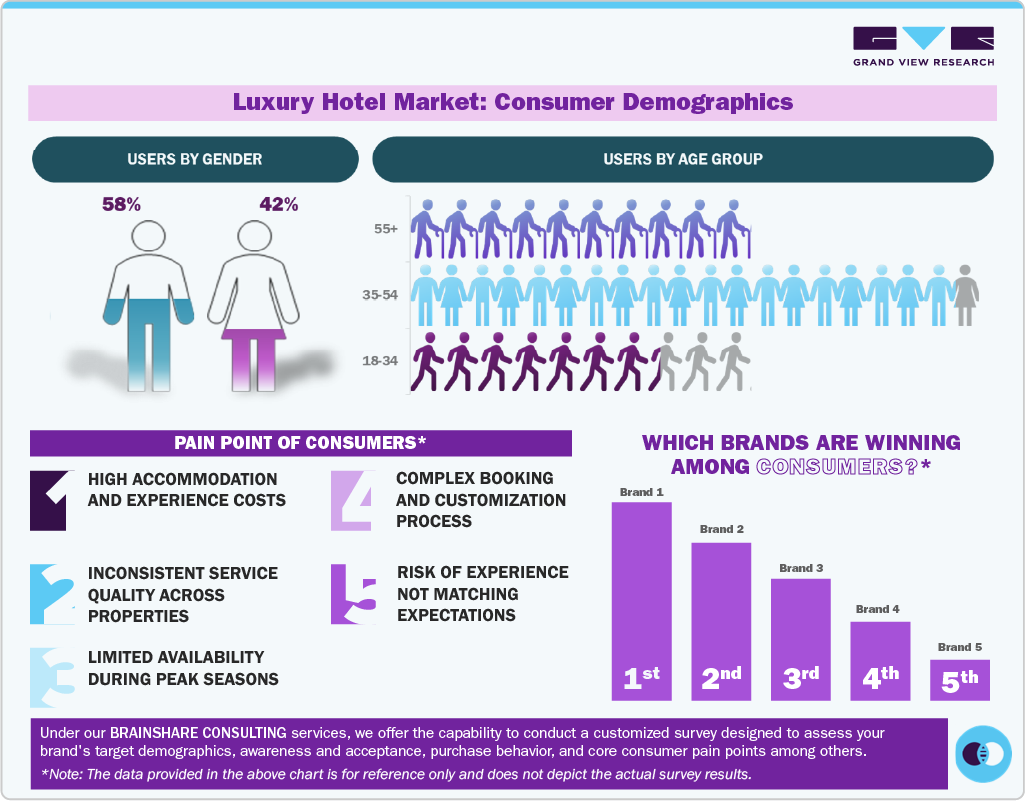
 Consumer Insights & Surveys
 To learn more about this report, Download Free Sample Report
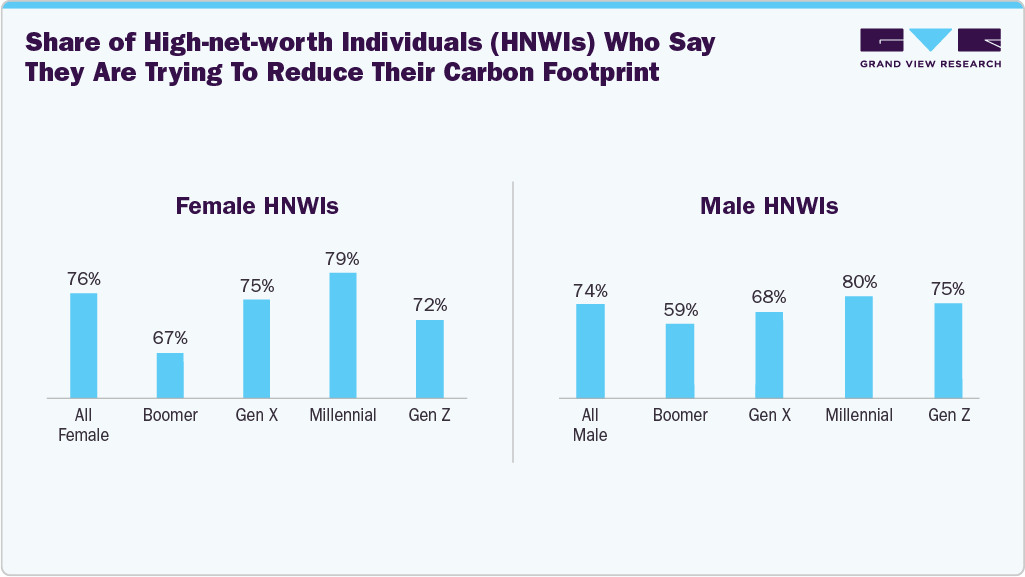
 The above data from the Knight Frank 2024 report shows a share of High-net-worth individuals (HNWIs) who say they are trying to reduce their carbon footprint. High-net-worth individuals (HNWIs) are increasingly prioritizing sustainability in luxury hotels, seeking accommodations that align with their values of environmental stewardship and cultural preservation. In response, brands like Six Senses, Four Seasons, and Soneva Fushi are integrating eco-friendly practices, such as renewable energy, waste management, and locally sourced dining, to meet these demands. Sustainable luxury hotels offer guests unique experiences that not only provide indulgence but also contribute to environmental preservation with initiatives like regenerative tourism and responsible construction. This blend of elegance and responsibility appeals to HNWIs who value both luxury and sustainability.
 To learn more about this report, Download Free Sample Report
 Category Insights
Luxury hotel chains accounted for a share of 65.2% of the overall market in 2025. Global operators such as Four Seasons Hotels and Resorts, Marriott International, Hilton, and Accor benefit from established brand equity, standardized luxury benchmarks, and strong relationships with institutional investors and developers. Their multi-brand strategies allow them to address different luxury price points and travel motivations while maintaining operational efficiency. In addition, centralized marketing, global reservation systems, and loyalty platforms enable higher occupancy and repeat visitation, reinforcing the dominance of branded luxury hotel chains within the global luxury hotel industry.
The independent luxury hotel segment is expected to grow at a CAGR of 8.6% from 2026 to 2033. The market is poised for growth due to its ability to offer personalized services, unique design, and authentic local experiences that resonate with travelers seeking individuality. Independent hotels excel in creating bespoke stays with a strong sense of place and cultural integration, while boutique hotels captivate guests with immersive experiences and distinct aesthetics. In addition, the rise of soft branding by major chains like Marriott and Hilton, through collections such as Autograph and Curio, supports independent hotels by blending their charm with global brand benefits, amplifying their appeal to a broader audience.
High-spending guests typically allocate budgets toward premium room categories, private villas, and add-on services such as spa treatments, curated dining, and exclusive excursions. Luxury stays are often planned around milestone occasions, destination weddings, anniversaries, wellness retreats, and private family travel, resulting in higher per-trip spend and longer average stays. Corporate-led demand, including executive off-sites and incentive travel, further supports premium room uptake and bundled service spending within luxury properties.
Type Insights
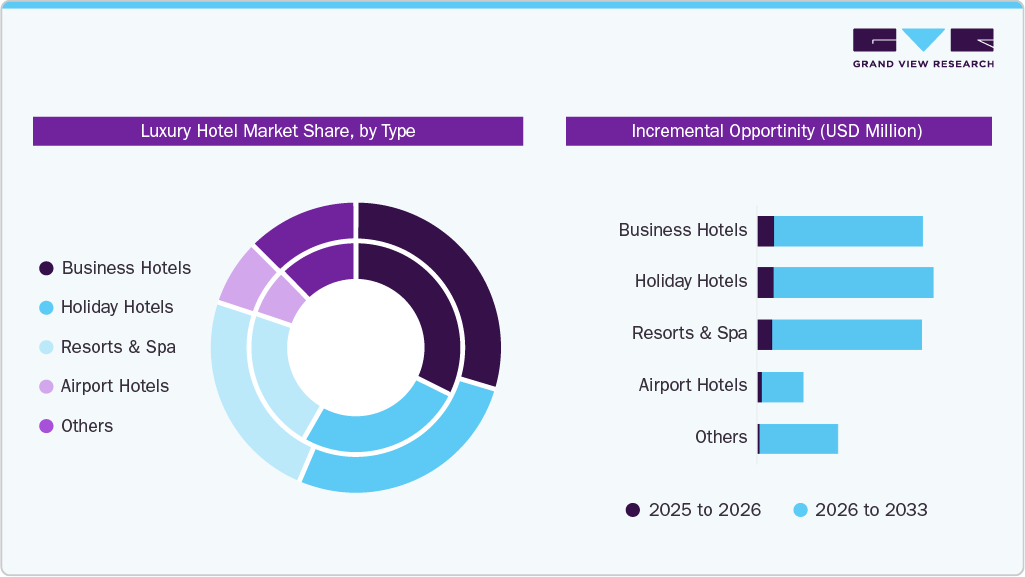
Business hotels held a market share of 32.3% in the overall market in 2025. Demand is anchored by multinational companies, financial institutions, and consulting firms that prioritize properties capable of supporting high-value meetings, executive stays, and extended work engagements. These hotels differentiate through advanced business infrastructure, discreet service models, and locations within major financial and commercial districts. The ability to host conferences, board-level discussions, and corporate events while maintaining luxury standards supports consistent occupancy and higher average room rates, reinforcing the importance of business hotels within the luxury hotel industry.
 To learn more about this report, Download Free Sample Report
 Demand for luxury resorts and spas is projected to increase at a CAGR of 8.5% from 2026 to 2033. High-end resorts such as Chiva-Som Hua Hin, Lefay Resort & SPA Lago di Garda, and Ananda in the Himalayas are gaining prominence by offering integrated programs focused on longevity, stress management, and holistic well-being. These properties attract guests seeking structured wellness journeys rather than conventional leisure stays. Growth is further supported by increasing willingness to spend on longer, restorative stays that combine luxury accommodation with evidence-based wellness therapies and nature-centric settings. Offerings such as Ayurvedic treatments, medical wellness consultations, hydrotherapy circuits, and mindfulness programs are becoming central to resort positioning. Sustainability, privacy, and low-density environments further enhance appeal among high-end travelers.
Booking Mode Insights
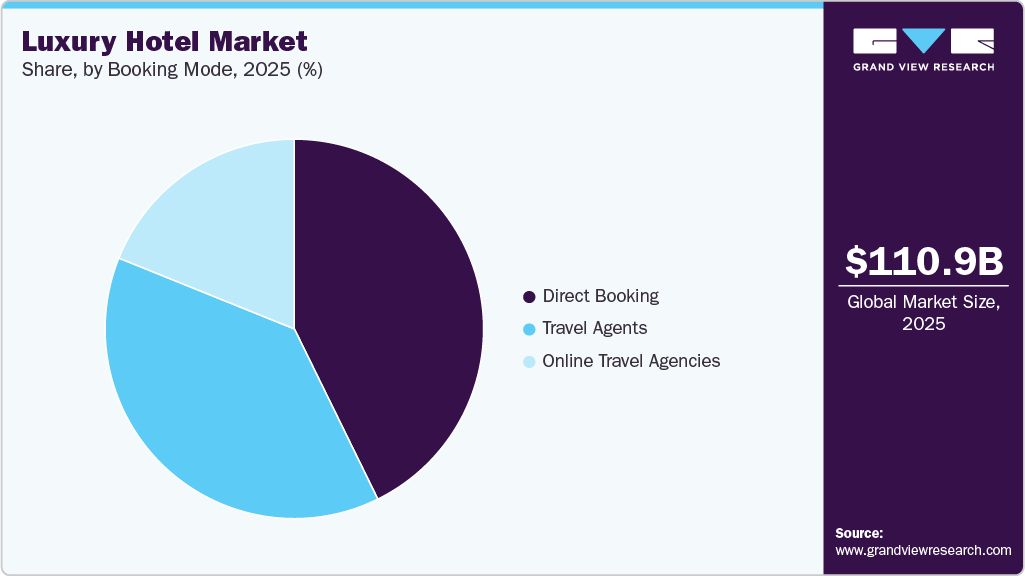
Booking luxury hotels through the direct booking mode accounted for a share of 42.7% of the overall market in the year 2025. Direct booking is more popular in the market because it allows hotels to offer personalized experiences, such as tailored wellness packages and exclusive upgrades that third-party platforms cannot provide. Affluent travelers prefer direct communication to ensure their specific preferences are met. In addition, direct bookings reduce commission costs, enabling hotels to invest more in enhancing guest experiences.
 To learn more about this report, Download Free Sample Report
 Booking through online travel agencies (OTAs) is expected to grow at a CAGR of 8.4% from 2026 to 2033. OTAs enable travelers to access a broad portfolio of luxury hotels and resorts in one place, supported by detailed content, guest ratings, and flexible booking options that increase confidence for premium purchases. Their ability to target travelers through data-driven promotions, international reach, and loyalty-based incentives is expanding their relevance among both experienced luxury guests and new entrants to upscale travel, reinforcing steady growth in OTA-led bookings.
Regional Insights
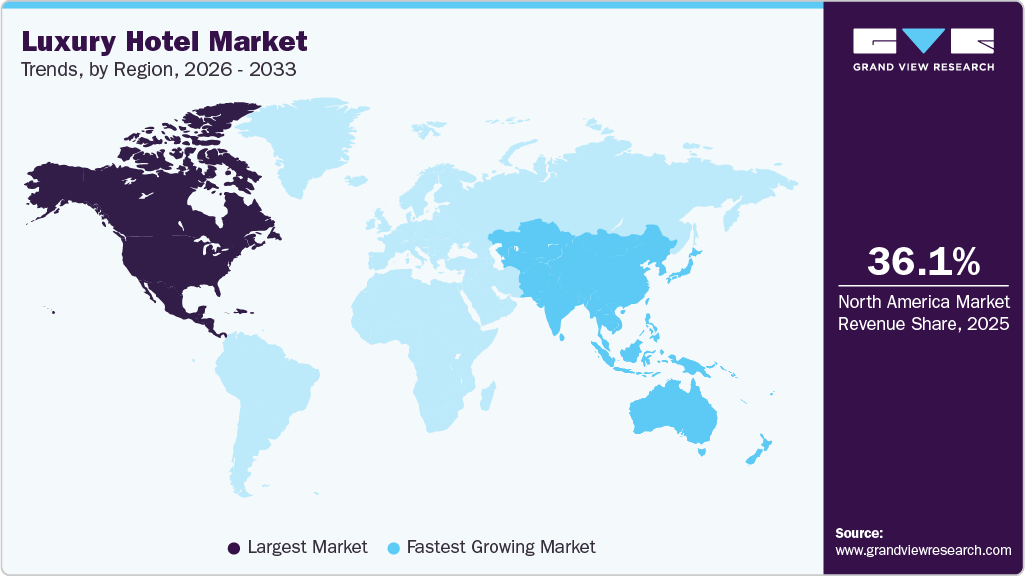
The luxury hotel industry in North America accounted for a global market share of 36.1% in 2025. The industry here is growing due to a strong rebound in travel demand, particularly from high-net-worth individuals (HNWIs) and millennials seeking premium experiences. The rise in domestic tourism, coupled with a growing preference for unique, personalized stays, has driven increased bookings. In addition, luxury brands are focusing on sustainability and exclusive offerings, further attracting affluent travelers.
 To learn more about this report, Download Free Sample Report
 U.S. Luxury Hotel Market Trends
The luxury hotel industry in the U.S. held a share of 87.8% of the North American market. The U.S. luxury hotel industry is dominant due to its diverse offerings and continuous innovation in major cities and emerging hotspots. Urban luxury hotels by global brands like Four Seasons and The Peninsula cater to affluent tourists and business travelers in hubs like New York and Miami. The rise of boutique hotels in cities like Austin and Nashville provides unique, culturally rich experiences for younger travelers. In addition, brands like Six Senses and Aman Resorts integrate wellness and sustainability, appealing to eco-conscious luxury travelers and driving industry leadership.
Europe Luxury Hotel Market Trends
The luxury hotel industry in Europe accounted for a share of about 28.5% of the global market in 2025. The European market is driven by the region’s dense concentration of established luxury destinations, strong inbound tourism, and high demand for experience-led stays. Europe benefits from a unique mix of urban luxury, resort destinations, and culturally significant properties that appeal to affluent international and intra-regional travelers. Demand is supported by sustained travel to major cities, strong leisure flows to coastal and countryside destinations, and consistent interest in long-stay and multi-destination itineraries. In addition, Europe’s emphasis on service excellence, culinary depth, and destination authenticity continues to attract high-spending travelers, reinforcing the region’s position as a core pillar of the global luxury hotel industry.
The luxury hotel industry in the UK is set to witness a CAGR of 9.2% from 2026 to 2033. The market is driven by strong inbound tourism, a dense concentration of high-net-worth visitors, and the country’s unique mix of urban, heritage, and countryside luxury offerings. London acts as the primary demand hub, supported by sustained business travel, premium leisure tourism, and international events, while secondary destinations such as the Cotswolds, Scottish Highlands, and Lake District attract affluent travelers seeking privacy and experiential stays. Demand is reinforced by the adaptive reuse of historic buildings into luxury hotels, a strong emphasis on service excellence, and a growing interest in wellness, gastronomy, and nature-led escapes.
Asia Pacific Luxury Hotel Market Trends
The luxury hotel industry in the Asia Pacific is set to grow at a CAGR of 8.9% from 2026 to 2033. The Asia Pacific luxury hotel industry is driven by rising affluent populations, strong domestic and intra-regional travel, and expanding premium tourism infrastructure. Demand is supported by increasing preference for high-end accommodations across major cities, resort destinations, and emerging cultural hubs, particularly in markets such as China, India, Southeast Asia, and Australia. Luxury hotels in the region benefit from longer stays, higher per-trip spending, and growing interest in personalized, experience-led travel that integrates local culture, wellness, and privacy.
Central & South America Luxury Hotel Market Trends
The luxury hotel industry in Central & South America is set to grow at a CAGR of 8.0% from 2026 to 2033. Countries such as Brazil, Mexico, Colombia, Chile, and Peru are attracting high-spending international travelers drawn to coastal resorts, rainforest lodges, wine regions, and heritage cities. Luxury hotels in the region increasingly differentiate through boutique-scale properties, experiential programming, and integration with local culture, cuisine, and landscapes. Continued investment by international luxury hotel brands, improvements in air connectivity, and growing appeal of eco-luxury and adventure-linked stays are reinforcing the steady expansion of the Central & South America luxury hotel industry.
Middle East & Africa Luxury Hotel Market Trends
The luxury hotel industry in Middle East & Africa is set to grow at a CAGR of 8.3% from 2026 to 2033. The region is benefiting from increased hosting of global events, exhibitions, and international sporting and cultural attractions, which drive demand for high-end accommodation across gateway cities and resort destinations. Luxury hotels are also capitalizing on demand for ultra-private stays, branded residences, and villa-based formats that appeal to affluent families and long-stay guests. Continued development of mixed-use hospitality projects, alongside improvements in connectivity and destination branding, is strengthening the Middle East & Africa region’s position in the global luxury hotel industry.
Key Luxury Hotel Companies:
The following key companies have been profiled for this study on the luxury hotel market.
- Accor
- Belmond Management Limited
- Four Seasons Hotel Limited
- InterContinental Hotel Group
- Mandarin Oriental Hotel Group Limited
- Marriott International, Inc.
- Rosewood Hotel Group
- The Indian Hotel Company Limited
- Radisson Hotel Group
- Aman Resorts
Recent Developments
-
In January 2025, St. Regis Hotels & Resorts opened The St. Regis Aruba Resort in Palm Beach, marking the brand's first presence in Aruba. The resort, designed by Hirsch Bender Associates, featured 252 luxurious guestrooms, including 52 suites. It combined Dutch-Caribbean culture with St. Regis' signature elegance, offering exclusive experiences like the island's first St. Regis casino and a rooftop restaurant by Chef Akira Back. The resort showcased the brand's legacy of refined luxury, enhancing Aruba’s hospitality scene.
-
In January 2025, Mandarin Oriental Hotel Group announced plans to open a new luxury resort and residences in Cabo Rojo, Puerto Rico, set to debut in 2028. The resort, part of the Esencia coastal community developed by Three Rules Capital and Reuben Brothers, will feature 106 rooms and suites, along with private villas, some with plunge pools. The property will offer five dining venues, a beach club, a Spa at Mandarin Oriental, a fitness center, and a Rees Jones-designed golf course. Additional amenities will include a children's club, event spaces, and an outdoor adventure center.
-
In December 2024, Hyatt Hotels & Resorts announced plans to open 50 luxury hotels by 2026, building on a successful 2024. In the past year, the company opened 28 upscale properties, including the Park Hyatt London River Thames and Thompson Palm Springs. Hyatt also acquired Standard International and the curated travel site Mr. and Mrs. Smith. The new hotels will be divided into two categories: the “Luxury Portfolio” for high-end properties and the “Lifestyle Portfolio” for culture-driven, trendy accommodations. The expansion is part of Hyatt's strategy to capitalize on growing demand in the luxury and lifestyle segments.
Luxury Hotel Market Report Scope
Report Attribute
Details
Market size in 2025
USD 110.9 billion
Estimated market size in 2026
USD 118.37 billion
Projected market size by 2033
USD 196.70 billion
Growth rate (Revenue)
CAGR of 7.5% from 2026 to 2033
Actuals
2021 - 2025
Forecast period
2026 - 2033
Quantitative units
Revenue in USD Billion, volume in number of rooms, and CAGR from 2026 to 2033
Report coverage
Revenue & volume forecast, company ranking, competitive landscape, growth factors, and trends
Segments covered
Category, booking mode, type, region
Regional scope
North America; Europe; Asia Pacific; Central & South America; Middle East & Africa
Country scope
U.S.; Canada; Mexico; UK; Germany; France; Italy; Spain; Japan; China; India; Japan; South Korea; Australia & New Zealand; Brazil; Argentina; South Africa; UAE
Key companies profiled
Accor; Belmond Management Limited; Four Seasons Hotel Limited; InterContinental Hotel Group; Mandarin Oriental Hotel Group Limited; Marriott International, Inc.; Rosewood Hotel Group; The Indian Hotel Company Limited; Radisson Hotel Group; and Aman Resorts
Customization
Free report customization (equivalent up to 8 analysts working days) with purchase. Addition or alteration to country, regional & segment scope.
Pricing and purchase options
Avail customized purchase options to meet your exact research needs. Explore purchase options
Global Luxury Hotel Market Report Segmentation
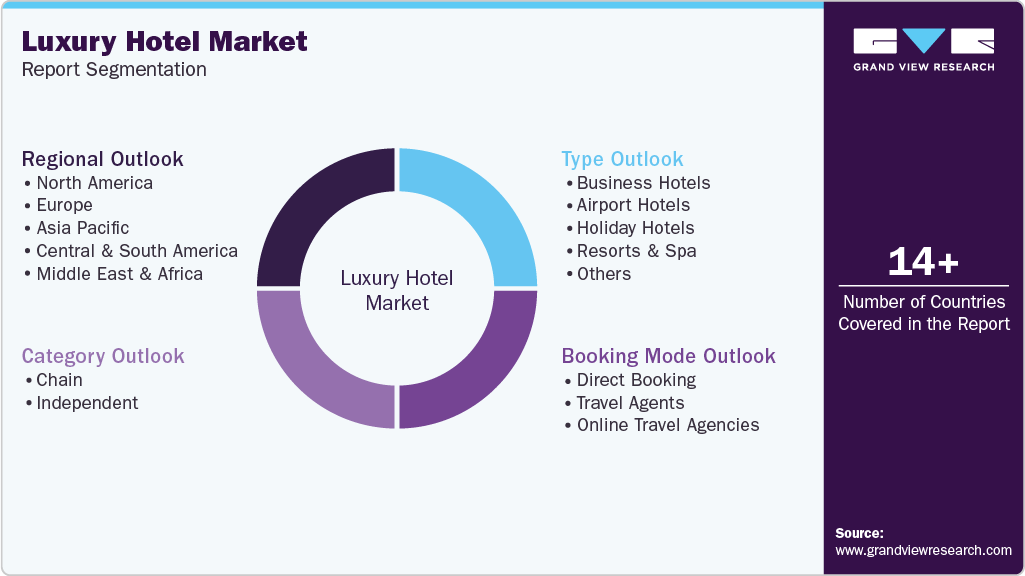
This report forecasts revenue & volume growth at the regional and country levels and provides an analysis of the latest industry trends and opportunities in each of the sub-segments from 2021 to 2030. For this study, Grand View Research has segmented the global luxury hotel market report based on category, booking mode, type, and region:
 To learn more about this report, Download Free Sample Report
 -
Category Outlook (Volume, Number of Rooms; Revenue, USD Million, 2021 - 2033)
-
Chain
-
Independent
-
-
Type Outlook (Volume, Number of Rooms; Revenue, USD Million, 2021 - 2033)
-
Business Hotels
-
Airport Hotels
-
Holiday Hotels
-
Resorts & Spa
-
Others
-
-
Booking Mode Outlook (Volume, Number of Rooms; Revenue, USD Million, 2021 - 2033)
-
Direct Booking
-
Travel Agents
-
Online Travel Agencies
-
-
Regional Outlook (Volume, Number of Rooms; Revenue, USD Million, 2021 - 2033)
-
North America
-
U.S.
-
Canada
-
Mexico
-
-
Europe
-
UK
-
Germany
-
France
-
Italy
-
Spain
-
-
Asia Pacific
-
China
-
India
-
Japan
-
Australia & New Zealand
-
South Korea
-
-
Central & South America
-
Brazil
-
Argentina
-
-
Middle East & Africa
-
South Africa
-
UAE
-
-
Frequently Asked Questions About This Report
Some key players operating in the luxury hotel market include Accor Hotels, Four Seasons Hotels Limited, Hyatt Corporation, InterContinental Hotels Group, Mandarin Oriental Hotel Group Limited, Marriott International, Inc., Rosewood Hotel Group, Shangri-La International Hotel Management Limited, The Indian Hotels Company Limited, and The Ritz-Carlton Hotel Company, L.L.C.
Key factors that are driving the market growth include emerging tourism and corporate industries across various regions, rising disposable income, increasing standard of living of people, and rise in preference for leisure travel.
North America dominated the luxury hotel market with a share of 36.1% in 2025.
Asia Pacific is the fastest-growing region over the forecast period.
The business hotels segment accounted for the largest share of 32.3% in 2025.
The direct bookings segment held the largest revenue share of 42.7% in 2025.
The global luxury hotel market size was estimated at USD 110.9 billion in 2025 and is expected to reach USD 118.4 billion in 2026.
The global luxury hotel market is expected to grow at a compound annual growth rate of 7.5% from 2026 to 2033 to reach USD 196.8 billion by 2033.
North America dominated the luxury hotel market with a share of 36.1% in 2025. The U.S. accounted for the largest revenue share in that market in 2024 since it is a global financial hub as well as one of the most popular tourist destinations for people across the world.
About the Author(s)
Homecare & Decor Research Team
Consumer Goods · Homecare & DecorThis report was authored by the homecare & decor research team at Grand View Research - comprising two research analysts, one senior research analyst, and one industry expert - with specialized expertise in the homecare & decor segment of the consumer goods industry. All findings are based on proprietary consumer goods databases, executive interviews, and regulatory analysis, subject to internal peer review prior to publication.
Last Updated:
Speak to AnalystNeed a Tailored Report?Customize This ReportCustomize this report to your needs - add regions, segments, or data points, with 20% free customization.
Or view our licence options:

ISO 9001:2015 & 27001:2022 Certified
We are GDPR and CCPA compliant! Your transaction & personal information is safe and secure. For more details, please read our privacy policy.
Loading...


Trusted market insights - try a free sample
See how our reports are structured and why industry leaders rely on Grand View Research. Get a free sample or ask us to tailor this report to your needs.


